Why tray airflow changes the bake
Pastry trays are more than a place to park product before baking. For croissants and Danish pastries, the tray surface controls how heat moves under the dough, how steam escapes, and whether the base sets at the same pace as the top browns. If airflow is too restricted, butter can pool under the pastry and leave a soft bottom. If airflow is too open, delicate pieces can spread, dry too fast, or mark unevenly where support is thin.
In a Johannesburg bakery, that balance matters because oven performance can shift through the day, especially when load shedding and start-stop baking change chamber temperature. A tray that behaves well in the morning may give a different result once the oven has recovered after power interruptions. That is why tray choice should match product weight, proofing time, and the speed of your line.
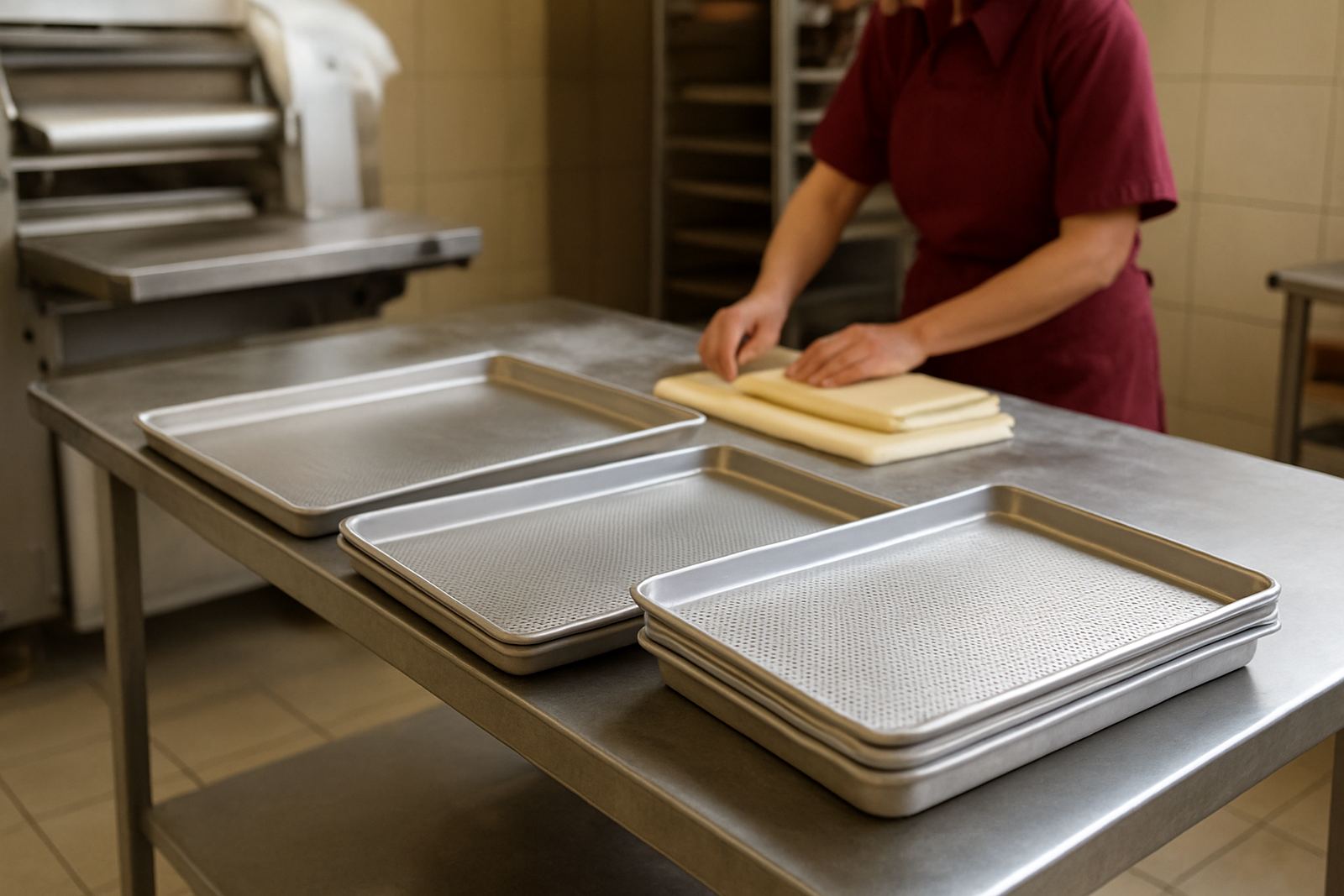
For laminated pastry, even small changes matter. A denser tray base gives steadier support, while a perforated tray gives faster heat transfer and better bottom colour. The right choice depends on whether you are after a soft, custard-style Danish base or a croissant with more crispness underneath.
Perforated trays for crisp bases and even colour
Not every pastry wants an open perforated base. Some Danish products do better on a smoother tray surface, particularly where the dough is soft after proofing or carries heavy filling. A flatter tray surface gives more support and can help keep shaping neat during transfer. This is useful when staff are moving trays by hand in a busy production room and there is not much time to correct misshapen pieces.
A smooth or lightly textured surface can also be easier to manage for product that carries fruit, custard, or sugar topping. Too much airflow under the tray can dry the bottom before the top has the colour you want. In that case, a tray with controlled drainage or smaller perforation works better than a fully open pattern. The goal is not only browning, but a pastry that cuts cleanly and holds together on the shelf.
For bakeries in Alberton or Boksburg that run early production for cafés, hotel breakfast service, or retail display, consistency matters as much as speed. If the pastry is going out by 6 am, the tray must help the finish stay neat from the oven to the counter.
Matching tray design to croissants and Danish products
Many bakeries in Gauteng start with one successful batch, then need the same result every week. That is where tray copying and prototype runs help. If a croissant tray is working in one branch but not another, we can compare the dimensions, edge profile, and perforation layout before making a repeatable batch. It saves time later, because staff are not trying to fix a poor fit with extra paper or makeshift spacing.
At our Alrode base, we often see requests from Soweto, Midrand and Germiston where production conditions differ from site to site. One bakery may have a smaller oven deck, another may use a convection unit, and another may need trays that fit their racking exactly. A tray that is 5 mm out can throw off tray spacing and airflow. Small errors become bigger problems once the bakery is working at full volume.
We also check whether the tray needs heavier gauge material for repeated use. If a bakery is baking day after day, the tray should not warp after a few cycles, because a slight twist can change how pastry sits and colours.
What local bakeries should ask before ordering pastry trays
The best pastry tray is the one your team can use day after day without fuss. It should load easily, stack neatly, and give the same bake across the batch. If it slows dispatch or forces operators to nurse each tray into place, it is costing more than it saves. Good tray airflow should support production, not add another problem.
For bakeries managing batch reorders, seasonal spikes and early morning dispatch, the right tray layout can keep the line moving. Whether the focus is a crisp croissant or a softer Danish finish, the answer usually comes down to careful matching of surface, hole pattern and gauge. Get those details right, and the pastry finishes the way the baker intended, not by chance.