Why tray perforation changes the bake
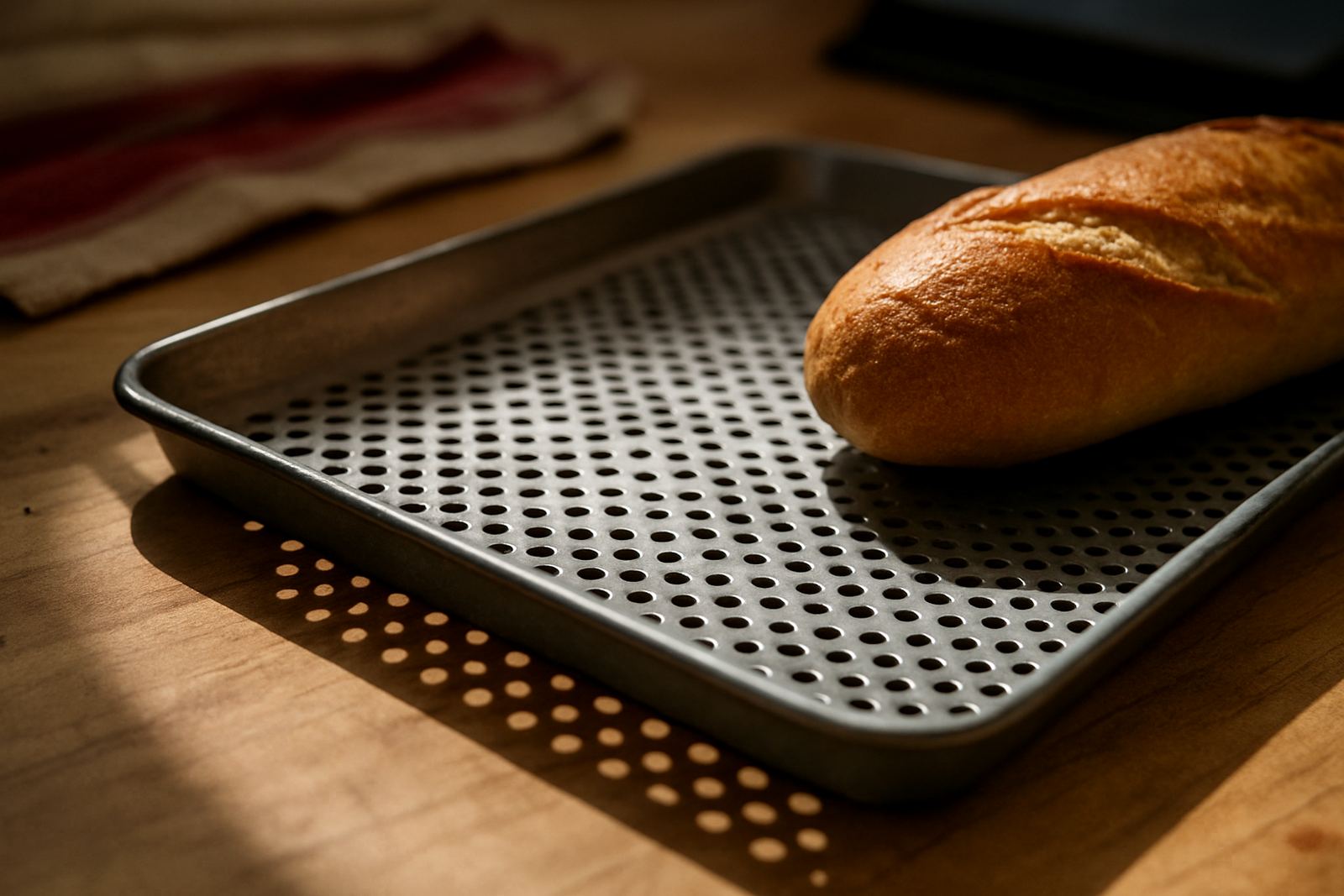
A solid tray holds heat well, but it also traps moisture under the product. A perforated tray gives hot air a way to move around the underside of the dough, so steam escapes faster and the base sets sooner. That can help buns, rolls, flatbreads and some pastry items develop a drier underside and a cleaner finish.
The main benefit is airflow. When air passes through the tray holes, the heat reaches the bottom of the product more evenly. This is useful where a bakery wants less soggy bottoming, better colour on the base and a firmer structure when the product comes out of the oven. On some items, the difference is small but still useful. On others it is enough to improve tray life and reduce complaints from shops or catering clients.
In practice, perforation works best when the product itself needs a bit of drying during the bake rather than holding in moisture all the way through. That is why tray choice should match the recipe, the oven type and the final finish you want.
Products that often benefit from perforated trays
Not every bake needs holes in the tray. But for products where a crisp base, open airflow or faster moisture release helps, perforation can be worth the change. Bakers in Alberton, Germiston and Boksburg often use perforated trays for repeat production where the same finish is needed on every batch.
- Rolls and burger buns that need a lighter underside and less sweating after baking
- Flatbreads, pizza bases and similar products that do better with direct heat movement
- Baguettes and long loaves where the crust needs to form quickly
- Par-baked items that will be finished later and need a cleaner base
- Short pastry items that must release steam without softening underneath
For richer doughs, very soft rolls, or products baked with a lot of moisture, a perforated tray may dry the base too fast. In those cases a solid tray or a different tray thickness may be the better option. If the product is already browning too quickly on the bottom, adding perforation can make the issue worse, so the full bake profile needs checking.
What bakery staff notice on the floor
The first sign is usually the feel of the base. A perforated tray can leave the underside firmer and less waxy, which helps when products are packed soon after baking. Staff also notice quicker release of steam on the tray itself, so there is often less condensation when trays come out of the oven and are moved to the cooling racks.
There are practical handling benefits too. In a busy production run, trays that dry out faster can be easier to turn around between batches, especially when the bakery is working with load-shedding windows and has to make the most of oven time. Less trapped moisture can also reduce the build-up of sticky residue, though cleaning still matters. A tray that is not cleaned properly will not perform well, no matter how many holes it has.
Some bakers prefer perforated tray only for the first part of the bake, then switch to another support method for finishing. That approach depends on the oven, the dough and the way the line is organised. If the bakery is moving trays between prep, proving and baking stations, consistency becomes just as important as heat.
When perforation is a better fit than a solid tray
Perforation is often chosen when a bakery wants more airflow without changing the product recipe. It can be a cleaner fix than adding more flour, reducing hydration, or changing the bake temperature. That said, it only works properly when the tray is built to suit the product weight and the duty cycle in the factory.
In humid areas, and especially on the coast, moisture can linger in the product longer and trays can feel damp for longer after wash-down. A perforated tray helps release some of that moisture during the bake. In Gauteng the air is drier, but bakeries still deal with steam from ovens, hot room temperatures and quick turnover. Either way, the tray needs enough strength to hold shape, because thin sheet with poor support can twist after repeated heating.
A few practical signs that perforation may help include:
- Bottoms that come out pale while the tops are already well coloured
- Bases that soften quickly after cooling
- Products that stick because moisture is trapped underneath
- Limited airflow in convection ovens with dense tray loading
How tray build affects the result
The hole pattern is only one part of the tray. Gauge, hole size, edge return and frame strength all affect how the tray behaves in heat. A heavy gauge tray can hold its shape better under repeated use, which matters when bakery teams are loading and unloading dozens of trays a day. A lighter tray may be easier to handle, but it can distort sooner if the product load is heavy or the oven temperatures are high.
We also check spacing and support. If the tray is perforated too tightly, it may still hold moisture around the base. If it is too open for the product, dough can mark or spread unevenly. Matching the tray to the item is often more useful than choosing a one size fits all solution. That is where size matching, pan copying and prototype runs save time later, because the finished tray is already closer to the way the bakery works.
For bakeries doing batch reorders, keeping the same hole pattern and thickness from one run to the next helps avoid small changes in bake colour. Even a small change in metal or perforation layout can show up on the floor, so the spec needs to stay clear.
A Johannesburg South example from a mixed bakery line
A bakery in the Johannesburg South area, supplying rolls and long loaf products to shops across Germiston and Midrand, wanted more even base colour without extending bake time. Their oven was already running close to capacity, and the team did not want to alter the recipe. A perforated tray test was set up on a smaller batch first, using the same dough, same proof time and same oven setting.
The result was a firmer underside and less steam build-up when the trays came out. The change was not dramatic on paper, but it mattered in dispatch because the product cooled more evenly and packed cleaner. The bakery still kept solid trays for softer items, which was the right call. For them, the benefit was not about replacing every tray in the factory, only using the correct tray where it made sense.
That is usually the best way to approach perforation. Start with one product group, check the base finish and cooling behaviour, then decide if the result is worth rolling out wider. It saves money and avoids unnecessary changes to a working line.
Getting the tray spec right before you order
If you are looking at perforated trays, the spec should be set before the order goes into production. The right questions are simple but important: what product is going on the tray, what weight must it carry, how hot is the oven, how often will the tray cycle, and how is it cleaned. A tray for a bakery in Soweto doing daily bread runs may need a different build from one used for a catering line in Midrand.
Useful details to confirm include:
- Exact tray length, width and lip height
- Perforation size and spacing
- Whether the tray must fit racks, loaders or dividers already in use
- Metal thickness and expected service life
- Whether the tray is for bread, rolls, baguettes or mixed use
Once those details are clear, the tray can be built to match the way the bakery works, not the other way round. That usually means fewer returns, less trial and error, and a cleaner result on the oven floor.